




Climate Change Act implementation support to Gauteng Province, Metros & Districts · Doc № 1010100 · 2026/06/03
How ready is Gauteng to implement the Climate Change Act?
An interactive digitisation of the readiness assessment for Gauteng Province, its three metros and two districts — 29 parameters, scored 0–5, across governance, mitigation planning, climate finance and MRV.
Average readiness score across all 29 assessed parameters. Prepared by Zutari (Pty) Ltd for Palladium, under UK PACT.
1.1 Background
In July 2024, South Africa promulgated the Climate Change Act 22 of 2024 (Act), which builds on the comprehensive National Environmental Management Act by establishing a robust legal framework aimed to enable the development of an effective national climate change response and a long-term just transition to a low-carbon and climate-resilient economy and society in South Africa. The Act recognises the country's international commitments, such as its status as one of the 196 signatories to the Paris Agreement. Over the last few years, countries have been submitting their national climate action plans, known as nationally determined contributions (NDCs). South Africa has committed to a 31% reduction in greenhouse gas (GHG) emissions, with a fixed target of 350–420 MtCO2e by 2030. Therefore, the Climate Change Act sets out the legal mandate for a countrywide climate change response, to enable the alignment of South Africa’s climate change response policy and actions, including mitigation and adaptation actions, which also constitute our country's fair contribution to the global climate change response.
In 2024, the National Planning Commission (NPC) conducted a study to assess the current constraints, capacity gaps, and limitations facing provinces and municipalities in complying with the Act. The study concluded that provincial, district, and municipal governments lack institutional capacities to comply with the provisions of the Act. The study noted that those institutions need to be strengthened to enhance their readiness to comply with the Act. The NPC therefore recommended that “implementing bodies should be provided with the requisite tools and knowledge” to meet the requirements of the Act.
Subsequently, there is a need to mainstream the climate change response into sectoral plans and across multiple levels and actors. This should be driven by a strong oversight function that aligns plans, policies, and strategies, sets and ensures standards and accountability, identifies and coordinates cooperation, and streamlines monitoring and reporting. A wide range of sectors are, and will continue to be, impacted by climate change, and so a rapid socio-economic transformation is required in order to reduce vulnerability and the effects of climate change.
The current project will focus on measures or programmes relating to climate change mitigation. Moreover, the assessment also considers the Act’s provision for a financing mechanism to support climate change response planning and implementation. This is important because climate finance is not only an explicit consideration in the Act through the provision for a finance mechanism but is also an implicit enabling condition for implementation more broadly. In practice, the ability of provinces, metros, and district municipalities to meet the Act’s planning and implementation requirements will depend in part on whether they have the institutional capability to identify, mobilise, allocate, and manage funding for climate-related priorities. Climate finance is therefore treated in this assessment as a practical delivery anchor. It provides the link between statutory planning requirements and the ability to implement climate responses in practice. On this basis, climate finance readiness is assessed not as a peripheral issue, but as a core dimension of whether these spheres of government are positioned to give effect to the Act.
1.2 Study area
This study and project cover the Gauteng province (Figure 1). The province has three metros (City of Johannesburg, City of Ekurhuleni, City of Tshwane), two districts (Sedibeng and West Rand), and six local municipalities (Lesedi, Midvaal, Emfuleni, Merafong City, Mogale City and Rand West City).
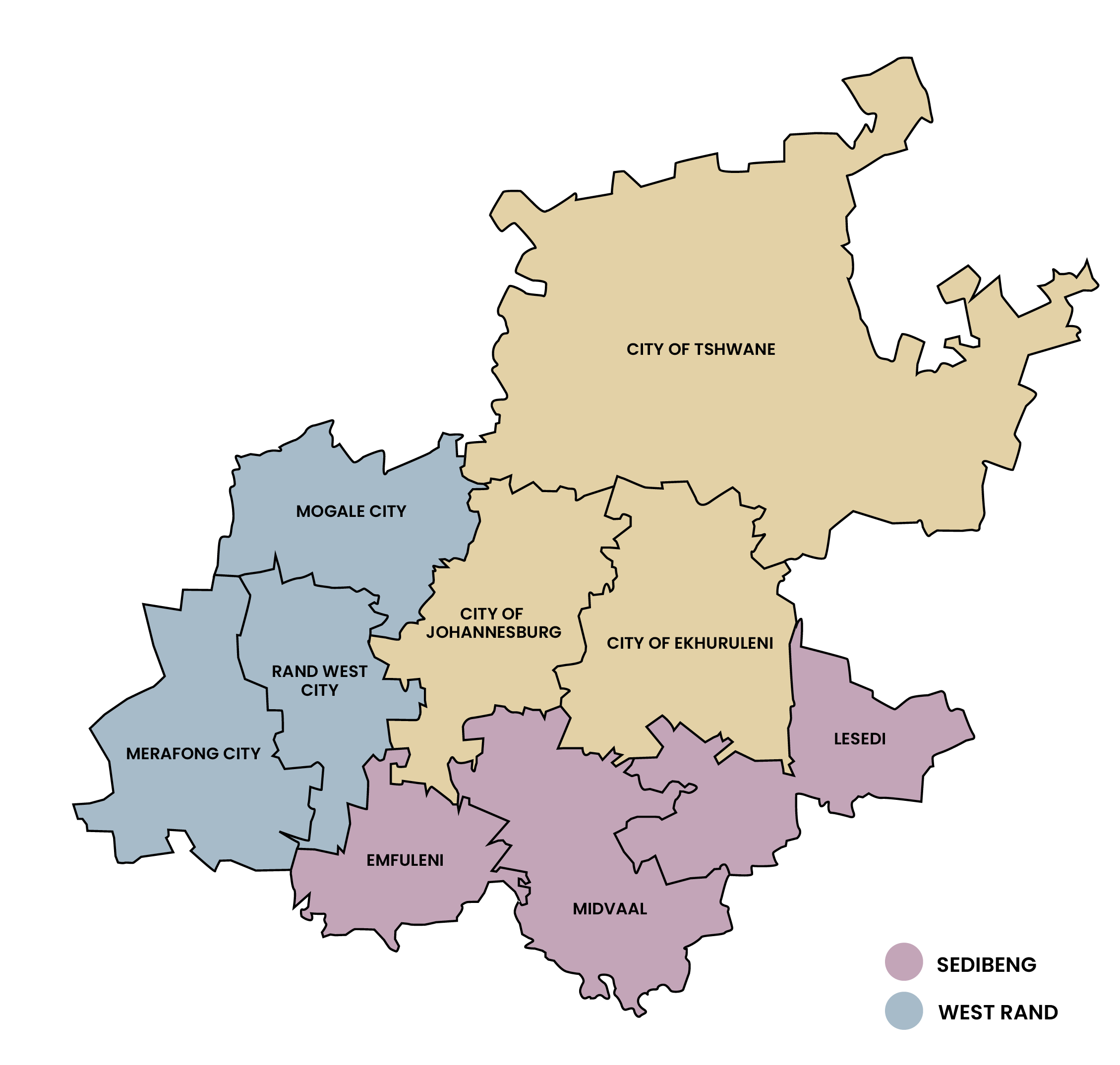
Figure 1: Map of Gauteng with districts, metros, and local municipalities.
1.3 Objectives
To implement policies that give effect to South Africa’s global commitment to reducing GHGs and ensuring a just transition, the National Planning Commission has introduced legislation that outlines a range of policy requirements across the province, districts, and metros. This project seeks to support Gauteng Provincial, metros, and district governments to build their readiness for the implementation of the Climate Change Act, with a focus on:
- Understanding their state of readiness for implementation of the Act, including understanding their needs and gaps, and understanding the statutory obligations created by the Act.
- Technical support to identify and articulate priority mitigation actions and develop climate change mitigation response implementation plans and mainstreaming of the mitigation actions into sector plans and strategies.
- Supporting the province, its metros and districts to establish and enhance their Measurement, Reporting and Verification (MRV) frameworks (including GHG inventory systems).
- Capacity building, knowledge sharing, networking, information exchanges, and institutional strengthening to enhance climate governance capacities for the implementation of the Act, and
- Support the province, its metros, and districts with leveraging, mobilizing, and accessing the requisite resources and climate finance towards implementation of the Act.
- Assess how the province, its metros and districts are affected by climate change on their constitutionally mandated functions.
- Determine the extent of integration of the Act into existing planning frameworks such as Municipal Integrated Development Plans (IDPs).
Climate Change Act key provisions and requirements related to provinces, districts and metros.
The Act is arranged into six chapters, with three schedules. The following are key explicit and implicit provisions and requirements related to provinces, districts and metropolitan municipalities (metros):
Chapter 1 states that the ACT is applicable within the borders of the Republic and that it binds all organs of state as defined in section 239 of the Constitution of the Republic of South Africa, 1996. It places a legal obligation on every organ of state to coordinate and harmonise their various policies, plans, programmes, decisions and decision-making processes relating to climate change, to ensure that the risks of climate change impacts and associated vulnerabilities are taken into consideration and give effect to the principles and objectives set out in the envisaged Act.
The chapter concludes by giving guidance that in the event of a conflict between a provision of this Act and other legislation in relation to climate change issues, the Climate Change Act prevails.
Chapter 2 demands that every organ of state that performs a function that is affected by climate change or a function related to a sustainable environment review, revise, amend, coordinate and harmonize their relevant policies, laws, measures, programmes and decisions as necessary to ensure alignment with this Act. It then goes on to mandate the existing Premiers’ intergovernmental forums established in terms of the Intergovernmental Relations Framework Act, 2005 (Act No. 13 of 2005), to also serve as Provincial Forums on Climate Change.
A Provincial Forum on Climate Change is charged with coordinating climate change actions in the relevant province and reports to the President’s Coordinating Council in terms of section 20(a) of the IGRFA. At district level, the chapter mandates all district intergovernmental forums, established in terms of the IGRFA, to also serve as Municipal Forums on Climate Change. These forums are charged with coordinating climate change actions in the relevant municipalities and report back to the relevant Provincial Forum on Climate Change.
This chapter is dedicated to provincial governments, district municipalities and metropolitan municipalities. It makes the following key requirements on provincial MECs and mayors of metropolitan or district municipalities:
Climate Change Needs and Response Assessments
It requires each of them to undertake a climate change needs and response assessment for the province, metro or district municipalities, as the case may be, within one year of the publication of the National Adaptation Strategy and Plan.
Based on the best available science, evidence and information, such a needs and response assessment must:
- Identify climate change response considerations and options
- Analyze the nature and characteristics of the province or metro or district municipality, as the case may be, and the particular and unique climate change needs and risks;
- Identify and spatially map, within the sphere of operations of the province, district or metropolitan municipality, as the case may be, risks, vulnerabilities, areas, ecosystems and communities that will arise, or that are vulnerable to the impacts of climate change;
- Identify and determine measures and mechanisms to manage and implement the required climate change response
It further requires that these needs and response assessments be reviewed, updated as necessary and published in the Gazette once every five years.
Climate Change Response Implementation Plans
Informed by the climate change needs and response assessment, the MECs and mayors of district municipalities or metros are then required to develop, implement and publish in the Gazette climate change response implementation plans for their respective areas of oversight, within two years of undertaking their climate change needs and response assessments.
These climate change response implementation plans must include measures or programmes relating to both mitigation of and adaptation to climate change. They also need to comply with any requirements that may be prescribed by the Minister responsible for environmental affairs (Minister), including any relevant technical guidelines that the Minister may develop.
The Act further requires that:
- Every provincial climate change response implementation plan forms a component of the respective province’s environmental implementation plan developed in terms of the National Environmental Act (NEMA), while
- Every metro or district municipal climate change response implementation plan forms a component of the relevant metro or district’s integrated development plan (IDP).
Similar to the needs and response assessments, these climate change response and implementation plans are also to be reviewed, updated as necessary and published in the Gazette every five years.
Climate Finance
The chapter concludes by charging the Minister to prescribe a mechanism to support and finance climate change response, planning and implementation by national, provincial and local government, in consultation with the Minister of Finance.
In this chapter, the Act highlights the importance of effective monitoring and evaluation for provinces, district municipalities and metros. The chapter allows the Minister to make regulations that will promote effective monitoring, evaluation and the assessment of national progress in responding to climate change, including progress made by provinces and municipalities in:
- Developing and implementing their climate change needs and response assessments, as well as
- Developing and implementing their climate change response implementation plans.
The table below summarises the Climate Change Act key provisions and requirements related to provinces, districts and metros.
Table 1: Climate Change Act requirements for provinces, districts & metros
| No | Requirements | Frequency | Office responsible | Province | Districts/ metros |
|---|---|---|---|---|---|
| 1 | The existing Premier intergovernmental forums must also serve as Provincial Forums on Climate Change. A Provincial Forum on Climate Change must:
| Premier | X | ||
Every district municipality and metros intergovernmental forum must also serve as a Municipal Forum on Climate Change. A Municipal Forum on Climate Change must:
| MEC/Mayor | X | |||
| 2 | Conduct a climate change needs and response assessment | Within one year of the publication of the National Adaptation Strategy and Plan | MEC/Mayor | X | X |
| 3 | Review, amend, and publish the climate change needs and response assessment | Once every five years | MEC/Mayor | X | X |
| 4 | Develop, implement, and publish a climate change response implementation plan. A plan should be informed by the climate change needs and response assessment and should also include mitigation measures or programmes. a. Province: must integrate the plans into the province's environmental implementation plan | Within two years of undertaking the climate change needs and response assessment | MEC/Mayor | X | |
| b. Metros/districts: must integrate the plans into the district or metro integrated development plan. | X | ||||
| 5 | Review, amend, and publish the climate change response implementation plan. | Once every five years | MEC/Mayor | X | X |
| 6 | Climate Finance The Minister must prescribe a mechanism to support and finance the Republic's climate change response, planning and implementation by national, provincial and local government in consultation with the Minister of Finance. | Minister of Environment | X | X |
This chapter outlines the approach followed to evaluate and assess the province, metros, and districts’ state of readiness for implementation of the Act, including understanding their needs and gaps, and understanding the statutory obligations created by the Act.
The assessment was carried out in four steps as follows:
Developed a gap and needs assessment framework, after which we
Collected data as required by the framework, and finally
Assessed the state of the province, and each district and metro against the requirements of the Act as disaggregated in the assessment framework
Presented, discussed and verified the results with the stakeholders.
Each of these steps is described in detail below.
3.1 Climate Change Act requirements disaggregated – Assessment Framework
This section disaggregates the Climate Change Act requirements for provinces, districts and metros into a framework that can be used to evaluate and assess the readiness of the provinces, districts and metros to implement the requirements of the Act. A table below shows the Climate Change Act requirements disaggregation, which was used as the readiness assessment for implementing the Climate Change Act by the provinces, districts and metros.
| Theme | Pillar | Core Parameters | ||
|---|---|---|---|---|
| A | Governance and Strategic matters | 1 | Climate Change Needs and Response Assessment | 1.1 Existence of a Climate Change Needs and Response Assessment, not older than 5 years |
| 1.2 Availability of staff with knowledge and skills to undertake a climate change needs and response assessment | ||||
| *This theme assesses institutional arrangements and appropriate coordination at the provincial, metro, and district levels that can enable the implementation of the Climate Change Act. | 2 | Institutional architecture, leadership, and coordination (Governance) | 2.1 Presence of dedicated climate change government officials in the province, district or metro | |
| 2.2 Existence of operational internal climate change coordination structure among departments in the province, district or metro (e.g. climate change committees) | ||||
| 2.3 Use of climate change key performance indicators (KPIs) in the province, district or metro | ||||
| 2.4 Provincial, district or Metro climate change forum operational | ||||
| B | Mitigation Planning and Implementation | 3 | Development and implementation of climate change mitigation strategies and response action plans | 3.1 Existence of a climate change strategy and/or action or implementation plan, with mitigation chapter, not older than 5 years |
| 3.2 Existence of climate change mitigation or net-zero goal(s) and target(s), not older than 5 years | ||||
| 3.3 Climate change projects included in the latest provincial environmental management plan or district/metro IDP | ||||
| 3.4 Evidence of integration of Climate change mitigation activities into departmental plans | ||||
| *This theme assesses whether the province, metro, and district can quantify emissions, and have set their targets to reduce their emissions and identify the mitigation response priorities. | 3.5 Integration of climate change considerations in other provincial, district and metro projects, programmes and strategies | |||
| 3.6 Availability of staff with skills in calculating the mitigation impact of projects | ||||
| 3.7 Availability of staff with skills in mitigation project identification, planning and setting of mitigation targets | ||||
| C | Climate finance | 4 | Resourcing the climate change mitigation strategy and action plan | 4.1 Existence of a financing strategy for climate action, not older than 5 years |
| 4.2 Integration of climate change projects in provincial, district and metro budgets and financial management processes | ||||
| *This theme assesses whether the province, metros, and districts have sufficient fiscal space, viable financing pathways, and the capability to mobilise resources to move from climate commitments to funded action | 4.3 Presence of government personnel with skill and knowledge to package projects in a form suitable for different funders and financing instruments | |||
| 4.4 Presence of government personnel with knowledge to undertake pre-feasibility, feasibility and costing of climate change projects | ||||
| 4.5 Structured cooperation with project preparation institutions, facilities and technical advisers | ||||
| D | Monitoring and Evaluation (Aka Measurement, reporting and verification - MRV) | 5 | Greenhouse Gas Inventories | 5.1 Availability of a GHG inventory tracking tool or system for data collection and compilation of GHG inventories |
| 5.2 Availability of staff with skills in the compilation of GHG inventories or carbon footprints | ||||
| 5.3 Existence of a published GHG inventory, not older than 5 years | ||||
| *This theme assesses whether the province, metros, and districts can effectively track and report progress and results on implementing climate change mitigation | 6 | Tracking and reporting on mitigation measures | 6.1 Existence of a register, database or system to track ongoing and implemented mitigation projects in the province/districts | |
| 6.2 Availability of staff with knowledge to track and report progress on mitigation measures and goals | ||||
| 7 | MRV of climate finance | 7.1 Availability of staff with climate finance capabilities | ||
| 7.2 Systems/processes/ tools for monitoring and reporting on own budget used for climate change response | ||||
| 7.3 System/process/tools for monitoring and reporting on other funding from within South Africa used for climate change response | ||||
| 7.4 Systems to track and report on international climate financial flows into the province, district or metros | ||||
3.2 Data collection approach
This information was obtained from workshops, interviews with provinces and districts, and the review of documents and materials provided for the assignment. Zutari, together with the provincial officials, had an inception meeting in February 2026, whereby initial data for this assignment were collected, followed by interviews and ad-hoc meetings. Some of the key documents reviewed includes the climate Action Plan/ Response strategy, Greenhouse gas inventories, Net-Zero guidelines, and climate change mitigation strategies. A figure below illustrates the data collection approach followed.

Figure 2: Data Collection Approach
3.3 Gap Assessment Process
The identified gaps were scored and prioritised using the framework below, based on the review of documents and materials provided. A simple 0–5 scale was selected to assess readiness across the framework. The scale is intended to distinguish between areas where no meaningful evidence exists, areas where systems or reports need review and update, areas where systems or practices are only emerging, areas where they are partially established, areas where they are in place, and areas where readiness appears mature and institutionalised. This approach provides enough differentiation to support comparative assessment while remaining practical and transparent.
Tap a score to activate the lens — the scorecards in sections 4 & 5 will animate to show only the parameters at that level. Tap 3 — Needs update, for instance, to isolate everything that exists but is due for revision.
3.4 Verification process
The final phase of assessing the province, as well as each district and metro to respond to the requirements of the Climate Change Act, involved validating the findings with stakeholders. Preliminary results were presented, discussed, and verified during a stakeholder workshop. Participants reviewed and refined pre-populated assessment frameworks for the province, districts and metros. The assessment results were subsequently updated and finalised based on the verified information provided by stakeholders.
Province’s state of readiness
Gauteng plays a pivotal role in advancing the transition to a low-carbon, resilient future as South Africa's economic hub. Gauteng has implemented several initiatives to mitigate climate change, focusing on reducing GHG emissions and transitioning to a low-carbon economy, including the development of an overarching strategy to guide its transition and curb emissions. In line with this commitment to inclusive climate action, Gauteng has launched several educational initiatives. One standout program is the Climate Change School Awareness Program, which emphasizes climate literacy in disadvantaged schools. The table below highlights the needs and the response for Gauteng province towards implementing the Climate Change Act.
4.1 Province’s state of readiness
The table below highlights the needs and the response for Gauteng province towards implementing the Climate Change Act.
Gauteng Province
As South Africa's economic hub, Gauteng plays a pivotal role in the low-carbon transition. Initiatives include an overarching climate strategy and the Climate Change School Awareness Programme focused on climate literacy in disadvantaged schools.
Table 4: The province’s needs and response assessment towards implementing the Climate Change Act.
Pillar 1 · Climate Change Needs & Response Assessment
avg 3Pillar 2 · Institutional architecture, leadership, and coordination (Governance)
avg 4Pillar 3 · Development and implementation of climate change mitigation strategies and response action plans
avg 3Pillar 4 · Resourcing the climate change mitigation strategy and action plan
avg 2Pillar 5 · Greenhouse Gas inventories
avg 3Pillar 6 · Tracking & reporting on mitigation measures
avg 3Pillar 7 · MRV of climate finance
avg 14.2 Individual District and Metros’ state of readiness
4.2.1 City of Johannesburg
City of Johannesburg (CoJ) joined the C40 Cities Climate Leadership Group in 2006, one of the first African cities to do so. The CoJ hosted the C40 Summit in 2014 and became the first African city to issue a green bond. Developed its first emissions inventory in 2014, with ongoing improvements. The city committed to the following C40 Declarations in its efforts to achieve its targets of reducing GHG emissions and improving climate resilience:
- To develop a Climate Action Plan.
- To achieve Net Zero Carbon Buildings by 2050, and to advance towards Zero Waste by 2050.
- Achieving an Equitable Low Carbon Transformation, geared towards pro-poor development.
Furthermore, Johannesburg received a high score from the CDP (global climate reporting platform) for the first time. The table below highlights the City of Johannesburg’s readiness to implement the Climate Change Act.
Table 5: City of Johannesburg's readiness towards implementing the Climate Change Act.
Pillar 1 · Climate Change Needs & Response Assessment
avg 3Pillar 2 · Institutional architecture, leadership, and coordination (Governance)
avg 2Pillar 3 · Development and implementation of climate change mitigation strategies and response action plans
avg 3Pillar 4 · Resourcing the climate change mitigation strategy and action plan
avg 0Pillar 5 · Greenhouse Gas inventories
avg 3Pillar 6 · Tracking & reporting on mitigation measures
avg 1Pillar 7 · MRV of climate finance
avg 04.2.2 City of Tshwane
The City of Tshwane hosted the second C40 Cities Regional Sustainability Masterclass from 20 to 21 November 2025. City of Tshwane is actively collaborating with the UCAP CAI programme to integrate climate goals into its core policy and finance structures, with a particular focus on addressing its highest-emitting sectors. The city is actively addressing its major challenges, guided by its current emission profile. While reliance on coal-generated electricity and growing energy insecurity remain key issues, the City of Tshwane is adopting an approach aimed at accelerating sustainable solutions in high-impact sectors. The table below highlights the City of Tshwane’s readiness to implement the Climate Change Act.
Table 6: City of Tshwane's readiness towards implementing the Climate Change Act.
Pillar 1 · Climate Change Needs & Response Assessment
avg 3Pillar 2 · Institutional architecture, leadership, and coordination (Governance)
avg 3Pillar 3 · Development and implementation of climate change mitigation strategies and response action plans
avg 3Pillar 4 · Resourcing the climate change mitigation strategy and action plan
avg 1Pillar 5 · Greenhouse Gas inventories
avg 3Pillar 6 · Tracking & reporting on mitigation measures
avg 1Pillar 7 · MRV of climate finance
avg 24.2.3 City of Ekurhuleni
The City of Ekurhuleni Metropolitan Municipality (CoE), home to an estimated 3.8 million people, is an important industrial and logistics hub in Gauteng Province, South Africa. Like other cities, it has prioritised responding to climate change through various initiatives, including the development of a Green City Action Plan. The plan outlines city-level policies, investments, and planning strategies that can be implemented to reduce the city’s carbon footprint in high-emitting sectors and ensure a greener and more resilient future. In addition, the CoE remains committed to being a carbon-neutral (net-zero) city by 2050. This is evident in its involvement with the C40 Cities Climate Leadership Group, ICLEI - Local Governments for Sustainability, and the Global Covenant of Mayors. The table below highlights the CoE’s readiness to implement the Climate Change Act.
Table 7: City of Ekurhuleni's readiness towards implementing the Climate Change Act.
Pillar 1 · Climate Change Needs & Response Assessment
avg 3Pillar 2 · Institutional architecture, leadership, and coordination (Governance)
avg 3Pillar 3 · Development and implementation of climate change mitigation strategies and response action plans
avg 4Pillar 4 · Resourcing the climate change mitigation strategy and action plan
avg 1Pillar 5 · Greenhouse Gas inventories
avg 3Pillar 6 · Tracking & reporting on mitigation measures
avg 1Pillar 7 · MRV of climate finance
avg 14.2.4 Sedibeng District Municipality
The Sedibeng Municipality has focused on climate change mitigation through renewable energy adoption, specifically by installing solar water geysers in low-to-middle-income households and launching air quality monitoring networks. The district has developed a Climate Change Mitigation Strategy and integrated green initiatives, such as exploring potential solar farms and renewable energy to transition toward a lower-carbon economy. The table below highlights the Sedibeng District Municipality's readiness to implement the Climate Change Act.
Table 8: Sedibeng District Municipality's readiness towards implementing the Climate Change Act.
Pillar 1 · Climate Change Needs & Response Assessment
avg 1Pillar 2 · Institutional architecture, leadership, and coordination (Governance)
avg 2Pillar 3 · Development and implementation of climate change mitigation strategies and response action plans
avg 1Pillar 4 · Resourcing the climate change mitigation strategy and action plan
avg 0Pillar 5 · Greenhouse Gas inventories
avg 0Pillar 6 · Tracking & reporting on mitigation measures
avg 0Pillar 7 · MRV of climate finance
avg 04.2.5 West Rand District Municipality
The district is investigating converting landfill waste (methane) into energy, aiming to address both waste management and greenhouse gas emissions. A table below highlights the West Rand District Municipality's readiness towards implementing the Climate Change Act.
Table 9: West Rand District Municipality's readiness towards implementing the Climate Change Act.
Pillar 1 · Climate Change Needs & Response Assessment
avg 1Pillar 2 · Institutional architecture, leadership, and coordination (Governance)
avg 1Pillar 3 · Development and implementation of climate change mitigation strategies and response action plans
avg 1Pillar 4 · Resourcing the climate change mitigation strategy and action plan
avg 0Pillar 5 · Greenhouse Gas inventories
avg 0Pillar 6 · Tracking & reporting on mitigation measures
avg 0Pillar 7 · MRV of climate finance
avg 0Identified gaps
This section presents the consolidated results across the province, metros, and districts, highlighting key strengths, gaps, and priority areas for action. It also supports the prioritisation of interventions and the identification of institutional, technical, and capacity-related needs. The table below provides a gap analysis assessing the readiness of Gauteng Province, its districts, and metros to implement the Climate Change Act.
The table below outlines the key recommendations aimed at addressing identified gaps and enhancing the readiness of the province, metros, and districts to implement the Climate Change Act.
Table 10: Identified gaps per core parameters in the province, districts, and metros
| Core parameter | Provincial | CoJ | CoT | CoE | SDM | WRM |
|---|---|---|---|---|---|---|
| A Pillar 1 · Climate Change Needs & Response Assessment | ||||||
| 1.1 Existence of a Climate Change Needs & Response Assessment, not older than 5 years | 4 | 3 | 4 | 4 | 0 | 3 |
| 1.2 Availability of staff with knowledge & skills to undertake a needs & response assessment | 3 | 2 | 2 | 2 | 1 | 1 |
| A Pillar 2 · Institutional architecture, leadership, and coordination (Governance) | ||||||
| 2.1 Presence of dedicated climate change government officials in the province, district or metro | 4 | 2 | 2 | 3 | 1 | 1 |
| 2.2 Existence of operational internal climate change coordination structure among departments in the province, district or metro (e.g. climate change committees) | 4 | 4 | 4 | 4 | 4 | 0 |
| 2.3 Use of key performance indicators (KPIs) in the province, district or metro | 4 | 2 | 2 | 4 | 2 | 1 |
| 2.4 Provincial, district or metro climate change forum operational | 4 | 4 | 3 | 4 | 4 | 0 |
| 2.5 Existence of structured engagements with public, private sector, civil society and other stakeholders | 4 | 0 | 4 | 1 | 0 | 0 |
| 2.6 Operational partnerships with research institutions and other technical bodies in climate change response | 3 | 0 | 2 | 1 | 0 | 1 |
| B Pillar 3 · Development and implementation of climate change mitigation strategies and response action plans | ||||||
| 3.1 Existence of a climate change strategy and/or action or implementation plan, with mitigation chapter, not older than 5 years | 3 | 3 | 4 | 5 | 0 | 1 |
| 3.2 Existence of climate change mitigation or net-zero goal(s) and target(s), not older than 5 years. | 3 | 3 | 4 | 5 | 0 | 0 |
| 3.3 Climate change projects included in the latest provincial environmental management plan or district/metro IDP | 3 | 4 | 4 | 4 | 1 | 2 |
| 3.4 Evidence of integration of Climate change mitigation activities into departmental plans | 3 | 4 | 4 | 3 | 3 | 0 |
| 3.5 Integration of climate change considerations in other provincial, district and metro projects, programmes and strategies | 3 | 0 | 4 | 4 | 0 | 1 |
| 3.6 Availability of staff with skills in calculating the mitigation impact of projects | 2 | 2 | 2 | 2 | 2 | 1 |
| 3.7 Availability of staff with skills in mitigation project identification, planning and setting of mitigation targets | 2 | 2 | 2 | 4 | 2 | 1 |
| C Pillar 4 · Resourcing the climate change mitigation strategy and action plan | ||||||
| 4.1 Existence of a financing strategy for climate action, not older than 5 years | 1 | 0 | 1 | 0 | 0 | 0 |
| 4.2 Integration of climate change projects in provincial, district and metro budgets and financial management processes | 3 | 1 | 1 | 1 | 1 | 0 |
| 4.3 Presence of government personnel with skill and knowledge to package projects in a form suitable for different funders and financing instruments. | 1 | 0 | 1 | 1 | 0 | 2 |
| 4.4 Presence of government personnel with knowledge to undertake pre-feasibility, feasibility and costing of climate change projects. | 1 | 0 | 0 | 1 | 0 | 1 |
| 4.5 Structured cooperation with project preparation institutions, facilities and technical advisers | 2 | 0 | 3 | 2 | 0 | 1 |
| D Pillar 5 · Greenhouse Gas inventories | ||||||
| 5.1 Availability of a GHG inventory tracking tool or system for data collection and compilation of GHG inventories | 3 | 2 | 2 | 3 | 0 | 0 |
| 5.2 Availability of staff with skills in the compilation of GHG inventories or carbon footprints | 2 | 4 | 2 | 1 | 0 | 1 |
| 5.3 Existence of a published GHG inventory, not older than 5 years | 3 | 3 | 4 | 4 | 0 | 0 |
| D Pillar 6 · Tracking & reporting on mitigation measures | ||||||
| 6.1 Existence of a register, database or system to track ongoing and implemented mitigation projects in the province/districts | 4 | 0 | 0 | 4 | 0 | 0 |
| 6.2 Availability of staff with knowledge to track and report progress on mitigation measures and goals | 3 | 2 | 2 | 3 | 2 | 0 |
| D Pillar 7 · MRV of climate finance | ||||||
| 7.1 Availability of staff with climate finance capabilities | 1 | 0 | 2 | 1 | 0 | 1 |
| 7.2 Systems/processes/ tools for monitoring and reporting on own budget used for climate change response | 3 | 1 | 3 | 1 | 1 | 0 |
| 7.3 System/process/tools for monitoring and reporting on other funding from within South Africa used for climate change response | 1 | 0 | 2 | 1 | 0 | 2 |
| 7.4 Systems to track and report on international climate financial flows into the province, district or metros | 0 | 0 | 2 | 1 | 0 | 0 |
The gap analysis per pillar is the average scoring per pillar. A table below highlights the gap analysis per pillar and comments on the identified gaps and needs at the provincial, metros and district level.
Table 11: Identified gaps per pillar in the province, districts, and metros
There are limited staff with knowledge and skills to undertake a climate change needs and response assessment. The provincial, CoT and CoE climate change needs and response assessments are up-to-date. However, there is no existing Climate Change Needs and Response Assessment for Sedibeng, while there is a need for an update and review for the West Rand District Municipality.
A defined climate institutional home is clear in GP, CoT, and CoE. There is evidence of progress in the CoJ, but important gaps remain. SDM and WRDM climate change work is combined with general environmental work; the institutional home is weakly evidenced in institutional architecture. SDM shows intention but no institutional home; there are early signs of progress within the WRDM. MCLM has a memorandum of Understanding/ MoA with the following institutions: UNISA, University of Johannesburg, and WITS, and has a KPI adopted by the council.
Strategic alignment is strongest in the Province, CoJ, CoT, and CoE; however, the strategies for Province, CoJ, and CoT are due for review and updates, while CoE has recently developed the strategy. SDM is emerging but lacks completeness; the strategy covers adaptation components and not mitigation. WRDM is currently developing a climate change implementation plan. MCLM has a climate change strategy, but it requires review to align with the Climate Change Act. There are limited skills and capacity to calculate the mitigation impact of projects; however, there are officials who have some skills. There is evidence of integration of the key performance indicators with departmental plans at the provincial level, CoJ, CoE, and Sedibeng, while the CoT has integrated climate change in the city plan and policies, e.g., budget tagging for mitigation and adaptation projects. Comprehensive Integrated Transport Plan (CITP), Assets Management Strategy, and there is a climate change chapter in Tshwane's IDP. There is no evidence for the WRDM; however, MCLM provides evidence during the Service Delivery and Budget Implementation Plan (SDBIP) as part of proof of evidence (PoE)
Financing pathways are understood at a provincial level, and there is an early sign at the Metro level, but fiscal constraints and limited own-revenue authority restrict district access to some climate finance instruments (such as debt). Metros all have strong track records in accessing climate finance debt markets. Districts have some evidence of accessing technical capacity support. However, it is not strictly climate finance related.
All three spheres (province, metros, and districts) don’t have a GHG emission tracking system. However, the province and the metros use an Excel-based tool to input data and calculate the emissions. Some provincial officials have done training on GHG inventory compilation and mitigation assessment, but there are limited capacity and skills in the compilation of the GHG inventory. The province and CoJ's latest GHG inventory are due for update and review, while CoT and CoE's GHG inventories are up-to-date. There is no GHG inventory for Sedibeng and West Rand district.
The province is developing a climate change MRV system, and there is no existing register, database or system to track ongoing and implemented mitigation projects in the metros and districts. Gauteng seems to be relatively stronger on mitigation data and MRV. The data is also more compatible with existing global standardised methodologies that are UNFCCC and IPCC-aligned. This is perhaps because emissions can be quantified and are comparable with specific indicators. Moreover, there are limited skills and capacity to track and report progress on mitigation measures and goals.
Climate finance monitoring and accountability systems are evidenced at the provincial, CoT and CoE. At the district level, the underlying foundations for monitoring, reporting, verification, and delivery exist within broader grant and public-sector reporting frameworks. However, there is little evidence of these being applied in a clearly established climate finance context.
Synoptic view
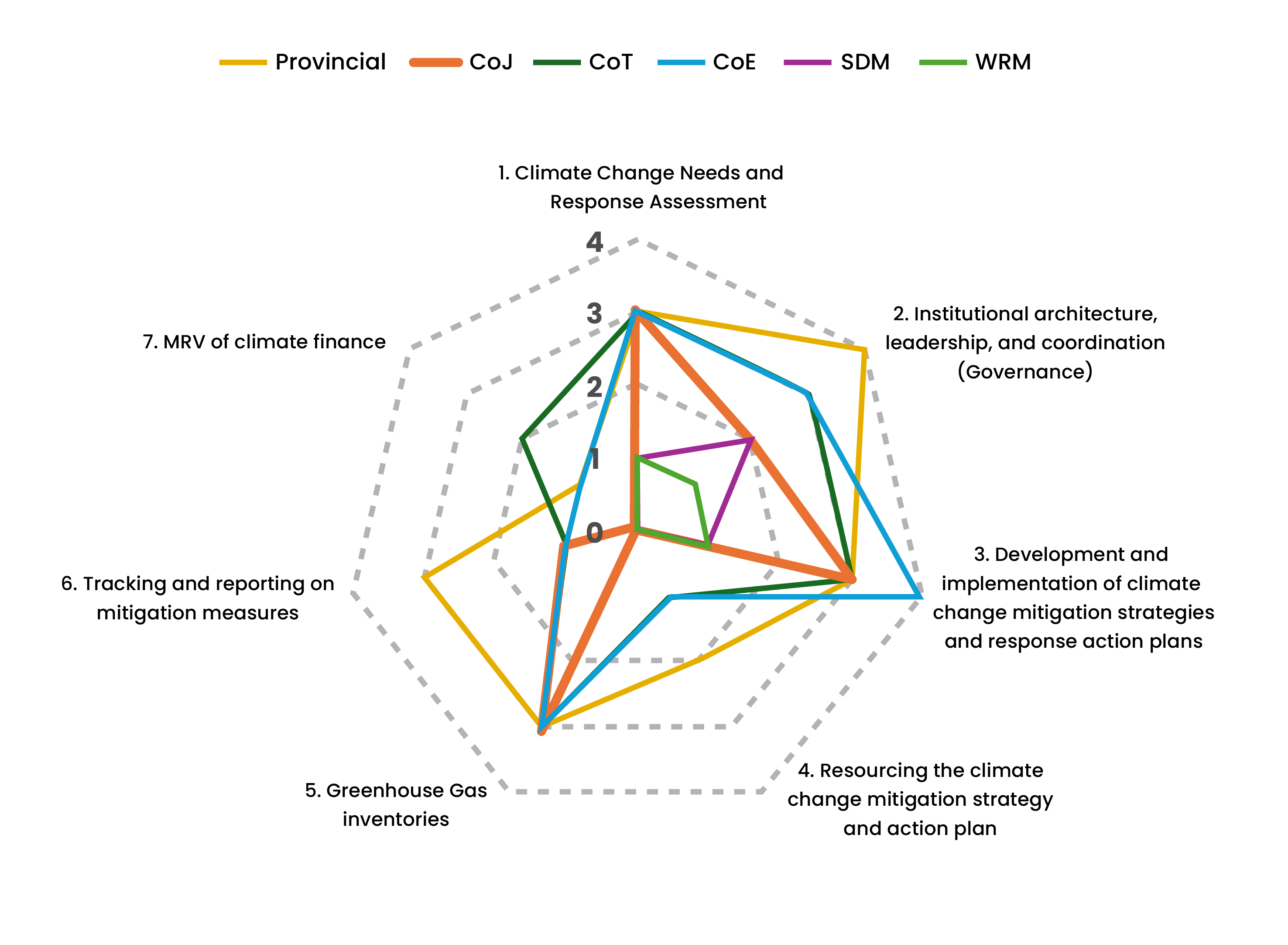
The findings of this assignment reflect the readiness of the province, metros, and districts to implement the Climate Change Act, including the identification of key gaps, needs, and statutory requirements. The assessment reveals limited capacity and skills to implement climate change interventions and climate finance activities, highlighting the need for strengthened capacity building, knowledge sharing, networking, information exchange, and institutional strengthening to improve climate governance for effective implementation of the Act.
It further indicates the need for support in identifying and prioritising mitigation actions, developing mitigation response implementation plans, and integrating these actions into sector plans and strategies, as well as enhancing the ability to leverage, mobilise, and access climate finance and other required resources. In addition, there is a clear need to establish and strengthen Measurement, Reporting and Verification (MRV) systems, including greenhouse gas inventory frameworks, to support effective tracking, reporting, and compliance.
Recommendations to close the gaps
This chapter presents recommendations to address the identified gaps and needs across the province, metros, and districts in relation to the implementation of the Climate Change Act. It also outlines how the current project will support the province, metros and districts in strengthening their climate governance, planning, reporting, and implementation capacities. Furthermore, the chapter highlights other ongoing initiatives and projects that are expected to contribute towards addressing some of the identified gaps and enhancing overall readiness for effective implementation of the Act.
Based on the identified gaps, there is a need to develop and implement training programmes for officials on climate change mitigation measures and Climate Change Act requirements.
For Sedibeng District Municipality, there is a need for the preparation of a comprehensive Climate Change Needs and Response Assessment in line with the Climate Change Act.
In addition, a need to undertake a review and update of the West Rand District Municipality Climate Change Needs and Response Assessment to reflect climate change mitigation responses, greenhouse gas emissions profiles, and legislative requirements.
To address the identified gaps on institutional architecture, leadership, and coordination, SDM and WRDM need to establish a formal and dedicated climate change coordination structure with clearly defined mandates and dedicated personnel to strengthen accountability and coordination. Climate change functions need to be elevated beyond general environmental management and integrated into key performance indicators, strategic planning processes, and performance management systems.
Effective collaboration between the province, universities, and other stakeholders needs to be expanded and replicated across all metros and district municipalities to enhance climate governance and strengthen institutional capacity.
Climate change mitigation strategies for the province, the City of Johannesburg (CoJ), and the City of Tshwane (CoT) need to be reviewed and updated to align with the requirements of the Climate Change Act and emerging climate priorities.
Sedibeng District Municipality (SDM) and West Rand District Municipality (WRDM) need to develop climate change strategies that include mitigation measures.
Capacity-building programmes need to be implemented to strengthen technical skills in greenhouse gas accounting, mitigation assessment, and the quantification of mitigation impacts, supported by the development of standardised tools and methodologies.
Furthermore, all metros and districts need to strengthen the integration of climate change objectives and key performance indicators into Integrated Development Plans (IDPs), plans, budgets, and performance management systems, to ensure climate change considerations are embedded in decision-making, implementation, monitoring, and reporting processes.
The province needs to strengthen guidance on climate finance pathways by developing a clear, structured framework that enables both metros and district municipalities to better understand, access, and utilise diverse financing instruments for climate action.
Capacity-building programmes need to be introduced to strengthen skills in climate finance mobilisation, project packaging, and proposal development, while also ensuring that technical support received is linked to climate change objectives.
Furthermore, the province, metros, and districts need to allocate dedicated resources and budgets for climate change activities, while leveraging partnerships with academic institutions and research organisations to build technical capacity and support evidence-based decision-making.
The province, metros, and districts need to establish a standardised greenhouse gas (GHG) emissions tracking and management system that enables consistent data collection, reporting, and monitoring.
There is a need for capacity-building programmes to strengthen technical skills in GHG inventory compilation, emissions tracking, mitigation assessment, and data management. GHG inventories for the province and the City of Johannesburg need to be reviewed and updated, while baseline GHG inventories for Sedibeng and West Rand District Municipalities need to be developed.
The finalisation and operationalisation of the provincial MRV system will support consistent tracking, reporting, and assessment of mitigation outcomes. However, there is a need to develop a metro and district register or database of ongoing and completed mitigation projects to enable consistent tracking, reporting, and evaluation of mitigation outcomes.
Capacity-building programmes need to be implemented to strengthen technical skills in MRV processes, emissions accounting, data management, and the monitoring of mitigation targets and indicators.
There is a need to develop climate finance monitoring, reporting, and accountability systems. The province, metros and districts need to strengthen climate finance monitoring, reporting, and accountability by integrating climate-related expenditure tracking into provincial and district financial management and reporting frameworks.
Ongoing initiatives already closing the gaps
This UK PACT-funded project, focusing on support to Gauteng and Limpopo provinces and their districts to comply with the requirements of the Climate Change Act, will address many of the gaps identified. The project will provide technical support to identify and define priority mitigation actions, as well as to develop, review, and update climate change response implementation plans, while ensuring the mainstreaming of mitigation measures into sector plans and strategies. In addition, it will support Gauteng province, metros and districts to establish the GHG inventory systems, develop and implement capacity building, knowledge sharing, networking, information exchanges and institutional strengthening to enhance climate governance capacities for the implementation of the Act. In addition, the project will support the province, metros and districts with leveraging, mobilizing and accessing the requisite resources and climate finance towards implementation of the Act.
Moreover, there are already ongoing efforts to close some of the identified gaps. This includes the development of the Gauteng MRV system to track and report climate change mitigation and adaptation actions across the province. The MRV system focuses on strengthening climate governance by standardising, consolidating, and analysing climate-related data from government, municipalities, and other stakeholders, while aligning reporting with national systems such as the NCCRD and NCCIS. Once operational, the MRV system will improve data collection, verification, and reporting, enabling evidence-based decision-making, enhanced climate finance access, and compliance with national and international reporting requirements, ultimately supporting Gauteng’s transition to a low-carbon and climate-resilient economy.
Secondly, provincial and municipal officials had a Gauteng 3-day Climate Finance Capacity-building workshop implemented under the Local Government Climate Change Support Programme (LGCCSP) by DFFE in partnership with GIZ. The workshop is designed to strengthen the skills of provincial and municipal officials in developing technically sound and financially viable climate finance projects and bankable proposals. It provides practical training in climate finance, project conceptualisation, costing, and proposal development, enabling participants to refine and validate project ideas for access to national and international funding. The workshop supports officials across key sectors to improve climate project planning and implementation, ultimately enhancing the ability of government institutions to mobilise climate finance and deliver effective mitigation and adaptation interventions that advance sustainable development in Gauteng.
The project remains committed to integrating Gender Equality, Disability, and Social Inclusion (GEDSI) throughout its delivery. In line with UK PACT guidance and Just Transition principles, this assessment considers inclusive participation and the needs of women, youth, vulnerable communities, and persons with disabilities, ensuring that no group is left behind in climate governance processes. GEDSI considerations will continue to be strengthened and monitored as the project progresses.